


Reluctant Revolutionary
A Hessian Comes to America
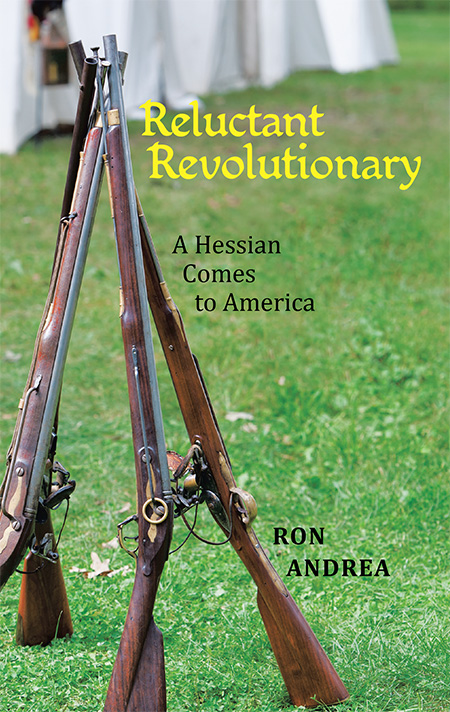
Not his country; not his king; not his war. What could possibly go wrong? In 1776, a young Hessian farmer is conscripted to fight a war on the other side of the world. A stranger in a strange land. He becomes a soldier and a man, but his biggest battles are within.
Who is he, and who is his neighbor?
Reviews
Hessian Reviews
This engaging, well-researched Revolutionary War adventure story follows a conscientious Hessian youth conscripted to serve on the British side. Jakob wants to enter manhood as a farmer, not a soldier, but he faces many privations, including ill-fitting shoes. He and his fellow conscripts face the gauntlet again and again, accumulating injuries that add to injury of ill-fitting shoes and the sickness from difficult sea crossings. The details of training and troop movements are well-researched. Young Jakob strives to learn English and after harrowing battle during which learns to hate war, he lodges with an American farm family. This novel presents a different perspective than many novels about the Revolutionary War and will appeal to readers of many ages, from high school to adults to those of us elders who had believed Hessian soldiers were mercenaries. Someone was paid by the British but not these young men whose families wanted them at home.
Helen Foster, author of Tidal Overlook
Ron Andrea’s debut, historical fiction novel, Reluctant Revolutionary, provides a glimpse at the little known story of conscripted soldiers fighting in America’s Revolutionary War. Building on the story of his fifth-great grandfather, Jakob Zike, Andrea wove a story that brilliantly reflects Jakob’s transition from a young, reluctant soldier for the British to a grateful immigrant embarking on a new life in a free, post-war America. Reluctant Revolutionary is as enlightening as it is entertaining. A must read for American history buffs.
Pam Webber, author of The Wiregrass series and Masawaa Note: I received a paperback review copy of this book from the author (who’s a Goodreads friend of mine). No inducements to, or guarantees of, a favorable review were requested or given.
Through much of recorded history, warring states hired foreigners to fight on their behalf. In Europe, the practice mostly fell into disuse during the long period of relative peace that followed the Napoleonic Wars. But it was still going strong at the time of the American Revolution, and the British government paid the Landgrave of Hesse-Cassel and other German princelings for the services of nearly 30,000 conscripts (describing them as “mercenaries” isn’t really correct, because they didn’t volunteer to sell their services, and they themselves didn’t get any of the British money!) to fight in its cause. Their perspective is one not often represented in Revolutionary War historical fiction. But here it’s front and center.
Our protagonist here is Hessian farm boy Jakob Zeuch [pronounced, I think, as “Zook,” if the last two letters are a “hard” ch; I’m not sure why most Anglophone characters want to pronounce it as “Zike”], 20 years old in the spring of 1776, when his Landgrave goes looking under every rock for 12,000 warm bodies to rent to his British nephew George III. Only sons (and Jakob is one) were previously guaranteed exemption from conscription; but when enough gold is at stake, guarantees don’t count for anything. So our hero is soon plucked from the little farmstead his family has tilled for over 200 years, to prepare for a voyage across the Atlantic to a continent he can picture only vaguely, to fight in a war he barely understands, let alone feels any stake in. This novel is his story; narration is in third person, but Jakob will be our sole viewpoint character. The prologue is set in late August 1776, when he’s already in America and on sentry duty near New York City, but his memories segue back to begin the main narrative in March 1776. All of the succeeding chapters (which catch up with him in late August and then follow him though his further wartime experiences) are superscribed with a locale and a date.
For independent author Ron Andrea, this is a first novel (though he previously wrote a nonfiction book, a popular-level treatment of St. Paul’s letter to the Romans). But it’s a very accomplished debut, written with an assured and fluent prose style, literary skill, and grounding in serious research which would do credit to much more experienced authors, including those favored with imprimaturs from Big Publishing. Two aspects of his background are important here. First, he’s a military veteran, having served for 30 years in the U.S. Air Force (including service in both the Vietnam and Gulf Wars), retiring with the rank of colonel. He understands both the psychology of combat and the experience of basic training from the perspective of the average “grunt.” True, Jakob trains with a flintlock musket, not an AK-47 (Ron’s enthusiasm for Revolutionary War nonfiction history comes in handy there!); but the ethos of training in both settings is very similar. Second, he’s a practicing Christian (part of the leadership/teaching team in his local church), and so able to enter into and share the mindset of his Christian protagonist, raised in a Lutheran home.
As the author’s short Historical Note at the end of the book states, Jakob Zeuch was an actual person (though most of the other characters here are fictional), and the Erbprinz Fusiliers, in which he served, was a real-life Hessian regiment; the experiences described here are based on the historical record of where the regiment was and what it was doing at the various times. This is fiction in the Realist tradition, and highly realistic Realism at that. Jakob’s training is described in great detail (his first two days in the army take up five chapters), and the plot reflects the reality that military service is often a matter of long periods of waiting and inaction; it’s not filled with combat, though when combat occurs it’s dangerous and stressful. Some readers will find this slow-paced, though it always held my interest. As a protagonist, Jakob is well-developed (the other characters are too) and likable; he’s uneducated but not stupid, curious enough to learn English, able to think for himself though not used to doing it, not a deep theological thinker but a serious believer who reads his Bible and cares about how he treats his fellow-human neighbor, steady, reliable, and able to earn respect from his peers and his sergeant. The title might seem to be something of a spoiler (but there’s more than one kind of “revolution”). No bad language or sexual content is included; as to violence, this is a war fought with live ammunition, but we’re not made to wallow in gore.
A short note on Reference Materials provides links (which would be clickable in the e-book edition, though I read the paperback) to three period maps, and to relevant websites or contemporary imagery. The Historical Note mentions that, besides the 7,000 German soldiers who died in this conflict (many more from disease than from combat), some 5,000 chose to settle here rather than return to Europe. And it also reveals an important source of the author’s inspiration for writing –but I’ll let readers discover this for themselves!
Werner Lind, author of Lifeblood, The Gift and Wolf Hunt.
About the Author
A lifelong reader and student of history, Ron Andrea was born in Los Angeles, California. He graduated from Southwestern College, Winfield, Kansas, and entered the United States Air Force in 1968. During his thirty years of military service, he served in the Vietnam and Gulf Wars, rose to the rank of colonel, commanding three different …
Learn MoreAbout the Book
Not his country. Not his king. Not his war. When twenty-year-old Hessian farmer Jakob Zeuch is conscripted into the forces hired to fight for King George III, his quiet life in the village of Niederdünzebach disappears overnight. Torn from his family, stripped of his identity, and thrust into the rigid world of the Erbprinz Fusilier …
Learn MoreBuy the Book
Reluctant Revolutionary brings to life the rarely told story of the Hessian soldiers—ordinary young men sent across the world to fight someone else’s war—and the extraordinary journeys that shaped them. ISBN 13 (SOFT): 9798385059263ISBN 13 (eBook): 9798385059256
Learn MoreMailing List!
